IJzerfrontommetje
Diksmuide
A short historical walk along the Frontzate, Stiltepad and Yser, through the former landscape of the Yser Front.
The walk
The IJzerfrontommetje starts at the IJzertoren in Diksmuide and heads towards the Yser via the Frontzate and Kaaskerke. The official basic loop is 5 kilometres. Add the out-and-back section to the Trench of Death and the walk comes to around 6 kilometres.
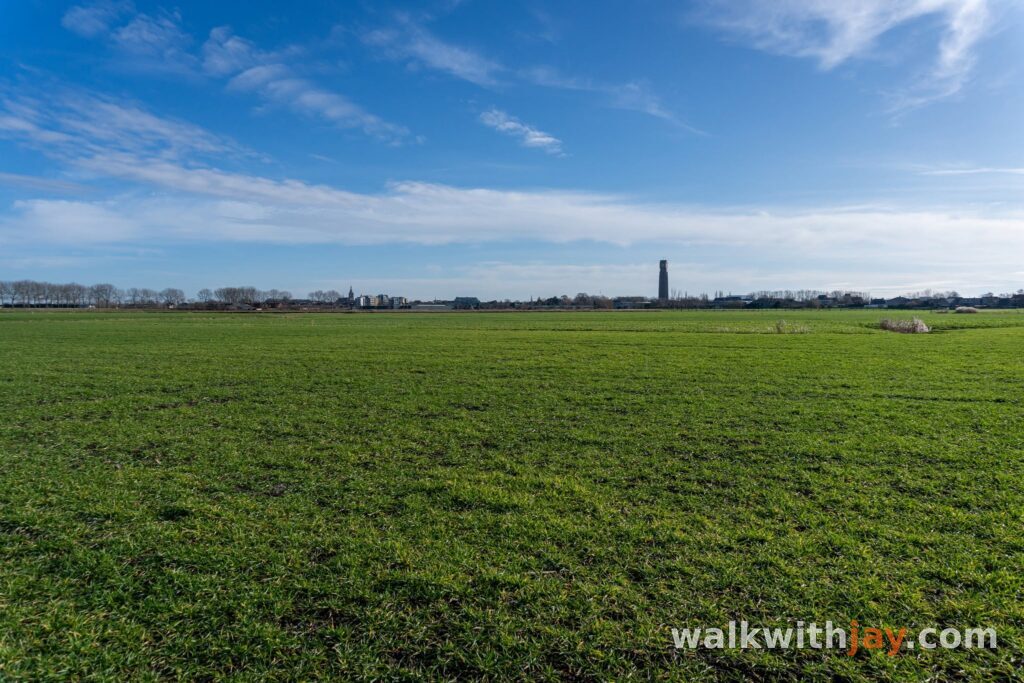
The route crosses open polder country where the First World War is still very much present in the landscape. A former railway line, old trench routes, memorials and the Yser itself make this a relatively short walk with a remarkable amount of history.
The IJzertoren and its turbulent history
The walk begins at the IJzertoren memorial site. After the First World War, the Flemish Front Movement developed an annual commemoration for Flemish soldiers who had died at the front. In 1924, the IJzerbedevaart committee bought a site at Kaaskerke where a large memorial would eventually be built.
In 1925, several hundred Heldenhulde headstones in military cemeteries were replaced by standard Belgian military headstones. Some of the original stones were broken up, with fragments even being used for road surfacing. The incident caused considerable anger within the Flemish movement and added further momentum to plans for a memorial of its own.
Construction of the first IJzertoren began in 1928 and the tower was inaugurated in August 1930. During the night of 15–16 March 1946, it was destroyed with explosives.
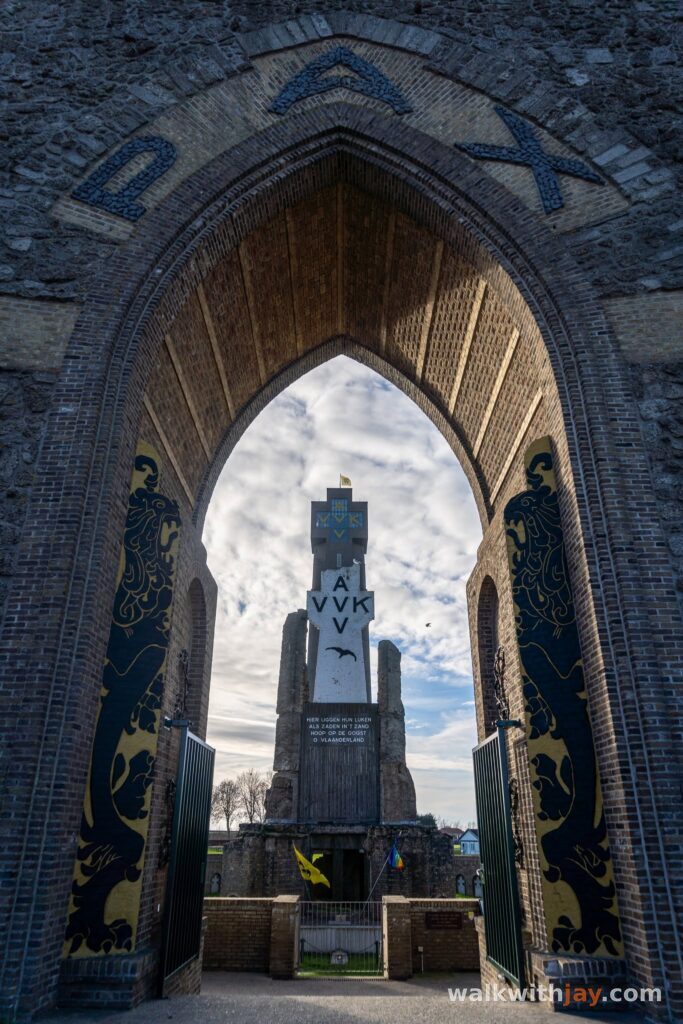
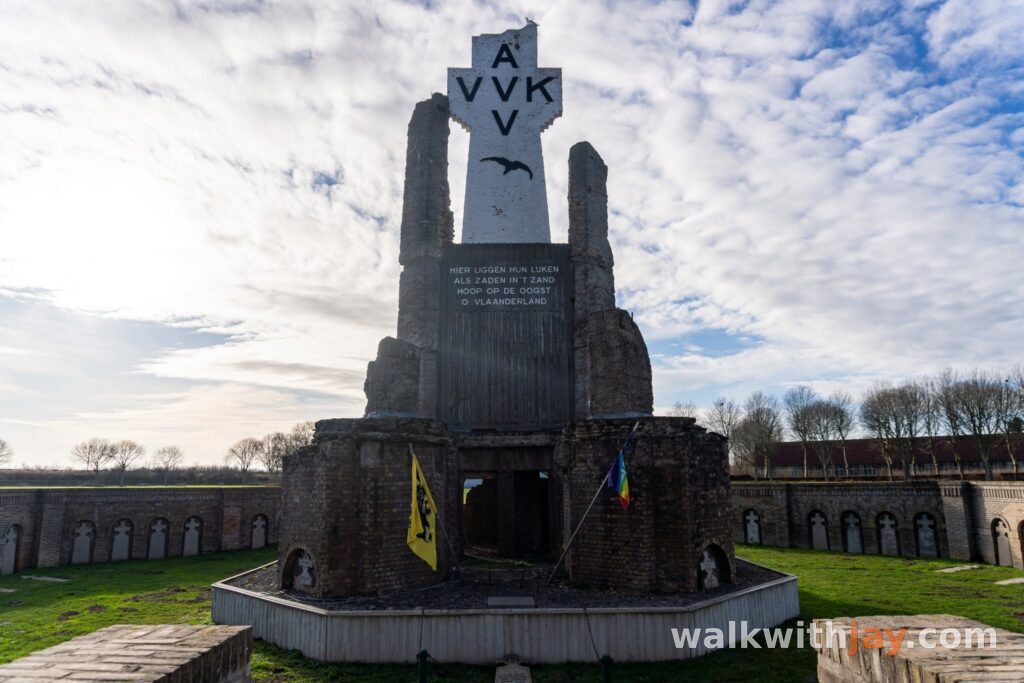
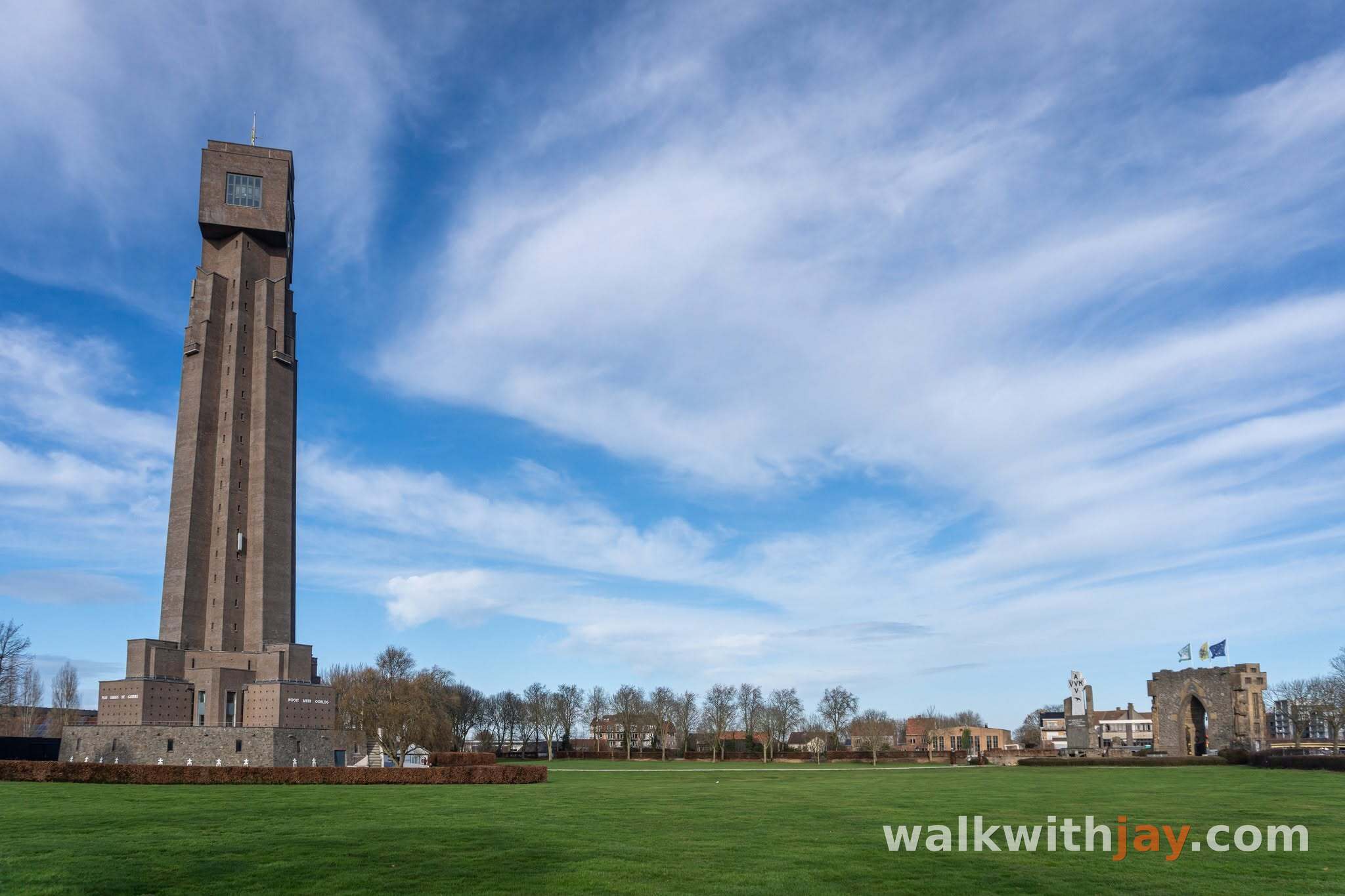
A large Heldenhulde cross was erected above the ruins in 1948. A year later, the Paxpoort was built using debris from the original tower. The present, much taller IJzertoren was built during the 1950s and inaugurated in 1965. Today it houses the Museum aan de IJzer.
Along the Frontzate and Stiltepad
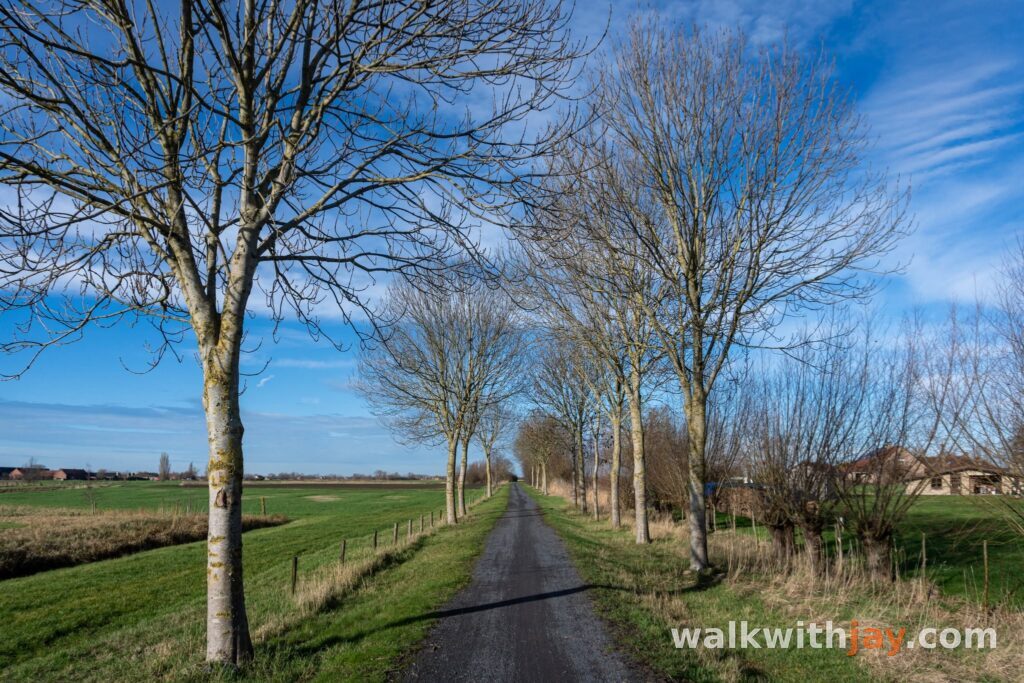
From the IJzertoren, the route heads towards Kaaskerke along the Frontzate, the former railway line between Diksmuide and Nieuwpoort. During the First World War, this slightly raised railway embankment ran straight through the front area. It was important for transport and supplies, but also became part of the Belgian defensive system.
At Oude Dorpstraat, the walk passes Kaaskerke cemetery. Before the war, the village centre and church stood here. Several older bluestone grave monuments survive in the cemetery, together with a number of wartime graves.
Behind the cemetery, the Stiltepad begins. The path follows the line of a former communication trench linking Kaaskerke with the Trench of Death, later known as the ‘Trench of Hope’.
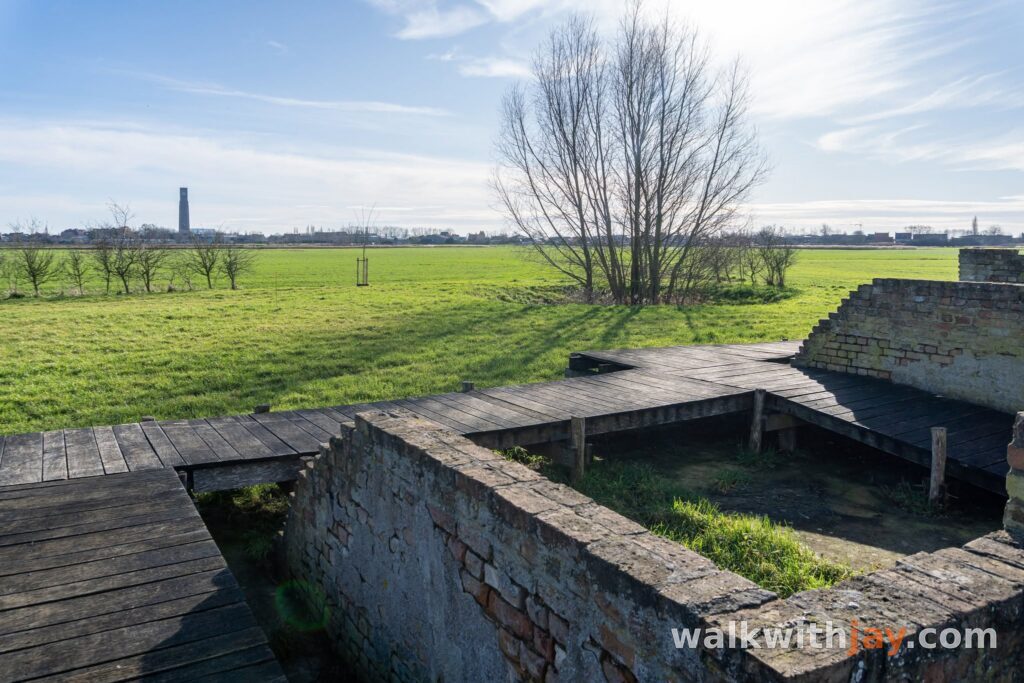
Out in the open polders, you also pass the ruins of Sabbe farm. The farm was rebuilt after the First World War, but today only parts of the later building remain.
The Trench of Death and the petroleum tanks
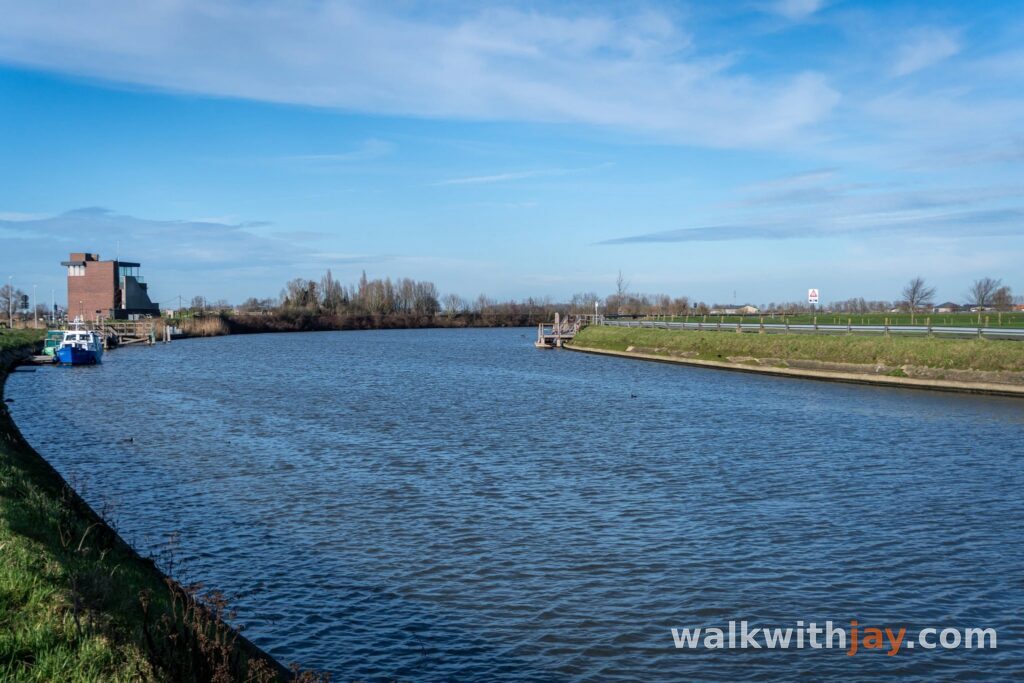
When you reach the Yser embankment, you can either return towards Diksmuide or extend the walk to the Trench of Death.
From 1915 onwards, this Belgian position was developed as an approach trench towards the German lines. In some places, the opposing positions eventually came extremely close to one another. The trench remained under fire for years and is now one of the best-known surviving Belgian trench sites on the Yser Front.
Continue for roughly another 500 metres beyond the Trench of Death and you reach the site of the petroleum tanks. Before the war, two large reservoirs stood here, storing petroleum brought in along the Yser.
From October 1914 onwards, the area remained in German hands. The metal structures stood out above the flat landscape and were used for observation. German troops in this area could also fire towards the Belgian positions around the Trench of Death.
The original tanks have disappeared. Since 2014, two half-scale replicas have marked their former location, making this part of the old front easier to understand.
Back along the Yser
The return route follows the Yser embankment towards Diksmuide. The landscape is completely open here, making it easy to imagine just how little natural cover soldiers had in this part of the front.
Along the way, you pass the Calvarieberg. This religious war memorial was inaugurated on 23 September 1928 in the presence of Prince Leopold, Princess Astrid and Bishop Waffelaert of Bruges. It was dedicated to Allied soldiers who had died on the Yser Front.
During the interwar period, the Calvarieberg was also seen as a Belgian patriotic counterpart to the Flemish IJzertoren taking shape on the opposite side of the Yser.
From here, it is only a short walk back to the starting point. In just a few kilometres, the IJzerfrontommetje brings together several very different parts of the former frontline landscape.
Photos from this walk




Jay’s tips
If you have a little extra time, continue beyond the Trench of Death to the petroleum tanks. That extra kilometre there and back makes the relationship between the Belgian positions and the former German-held ground much easier to understand.
Good to know
Little shade
Picnic area or benches
Museum nearby
Bus stop near the start
Heritage or historical site
Monument
Military heritage
Cemetery
War cemetery
Memorial or commemorative monument
The official basic loop is 5 kilometres. Including the Trench of Death brings the walk to around 6 kilometres. If you also continue to the petroleum tanks, allow roughly another kilometre. Much of the route crosses open polder country, so there is very little shade. There is a picnic area with a memorial bench along the Stiltepad.
My experience
For such a short walk, I found the IJzerfrontommetje remarkably rich in history. The Frontzate, Stiltepad and Yser embankment are fairly simple stretches of walking in themselves, but the way you look at the landscape keeps changing as you move from one historical site to the next.
The section from the Stiltepad towards the Trench of Death was the strongest part for me. You first walk quietly through the polders and then arrive almost suddenly at one of the best-known Belgian positions on the Yser Front. If you continue to the petroleum tanks, the distance between the two sides of the former front becomes even easier to understand.
I would not choose this route specifically for nature or varied scenery. If you are interested in the First World War, though, there is an impressive amount to see within a relatively short distance.
Waymarking
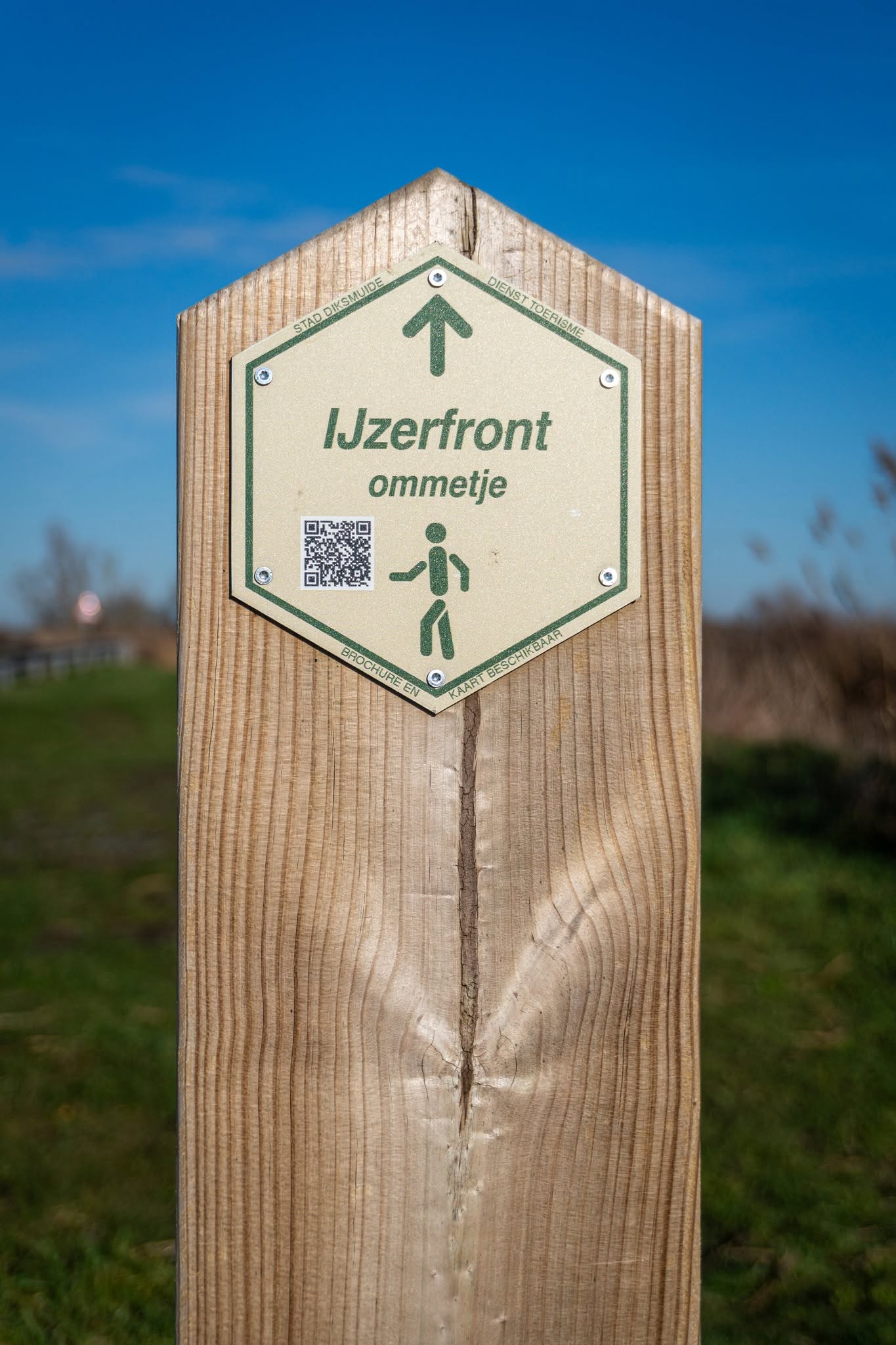
IJzerfrontommetje
Places of interest
IJzertoren en Museum aan de IJzer
At start/finish
Memorial site with the IJzertoren, Paxpoort, crypt and museum exploring war, peace and Flemish emancipation.
IJzerdijk 49, 8600 Diksmuide, Belgium ↗
Website →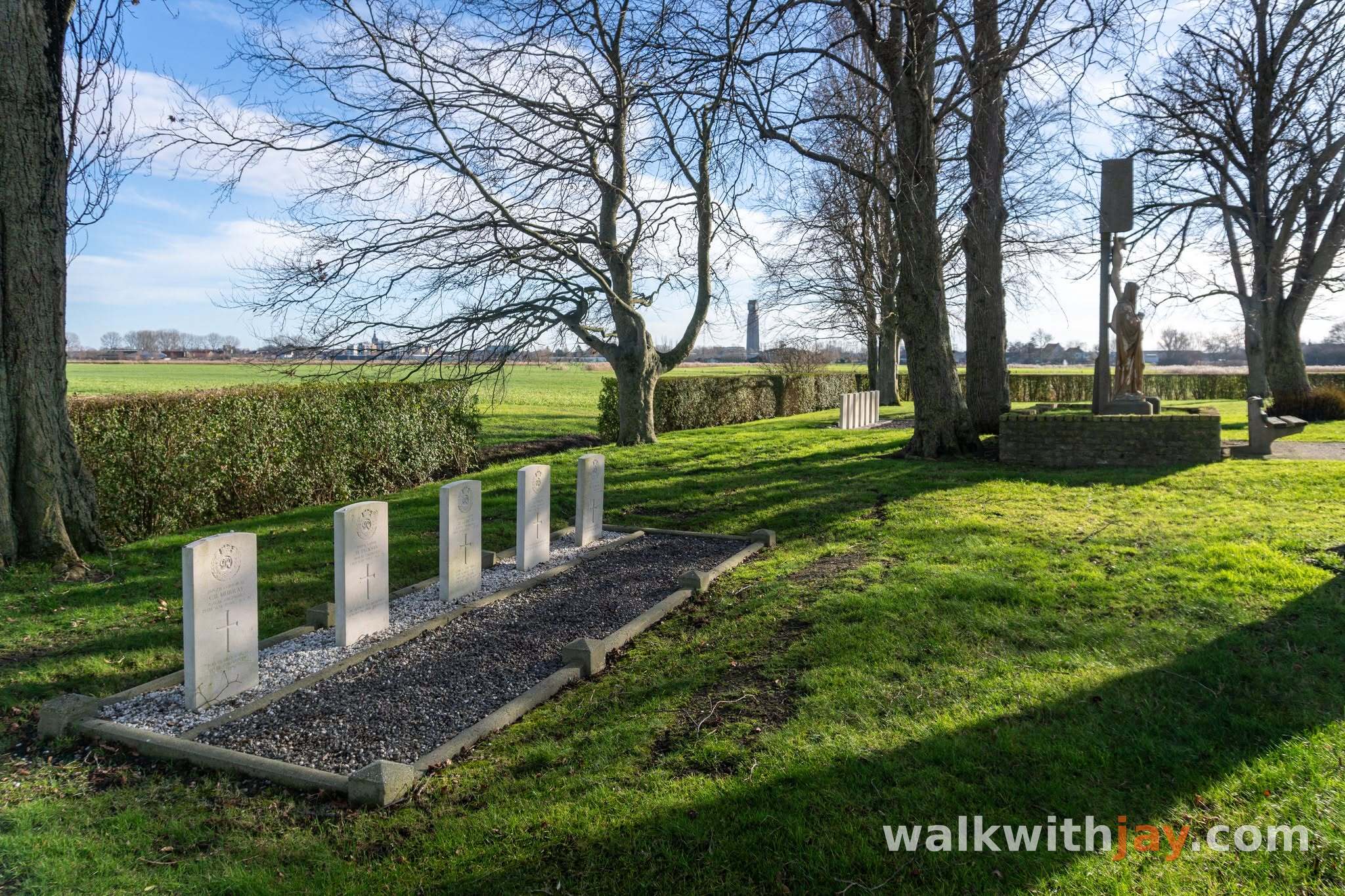
Begraafplaats Kaaskerke
Along the route
Cemetery on the site of Kaaskerke’s pre-war village centre, with older grave monuments and several wartime graves.
Oude Dorpstraat, 8600 Kaaskerke, Belgium ↗
Website →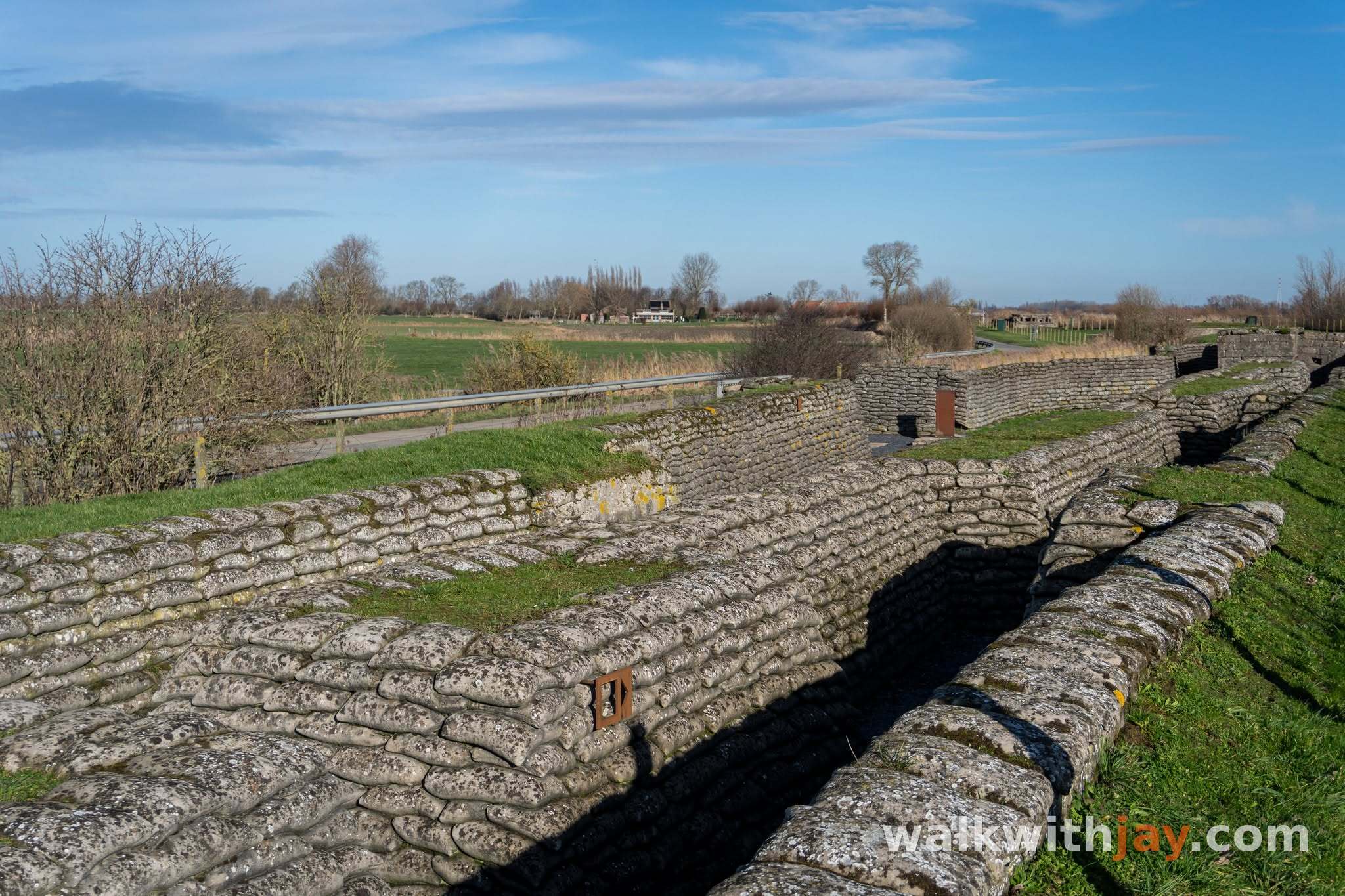
Dodengang
Along the route
Preserved Belgian trench system beside the Yser, developed from 1915 and facing German positions at very close range.
IJzerdijk 65, 8600 Diksmuide, Belgium ↗
Website →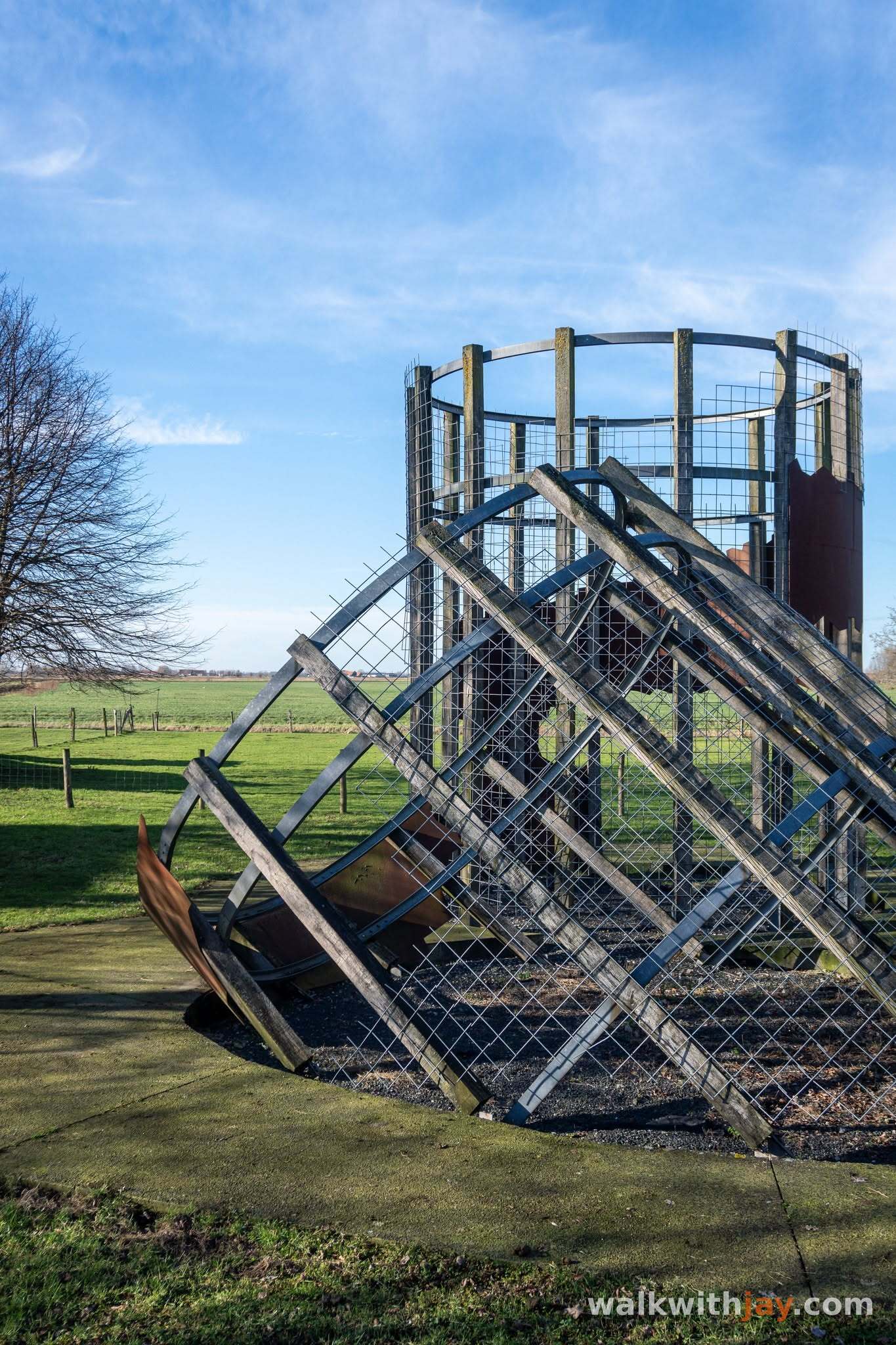
Petroleumtanks
Along the route
Two half-scale replicas mark the site of petroleum tanks that remained in German hands during the First World War.
IJzerdijk, 8600 Diksmuide, Belgium ↗
Website →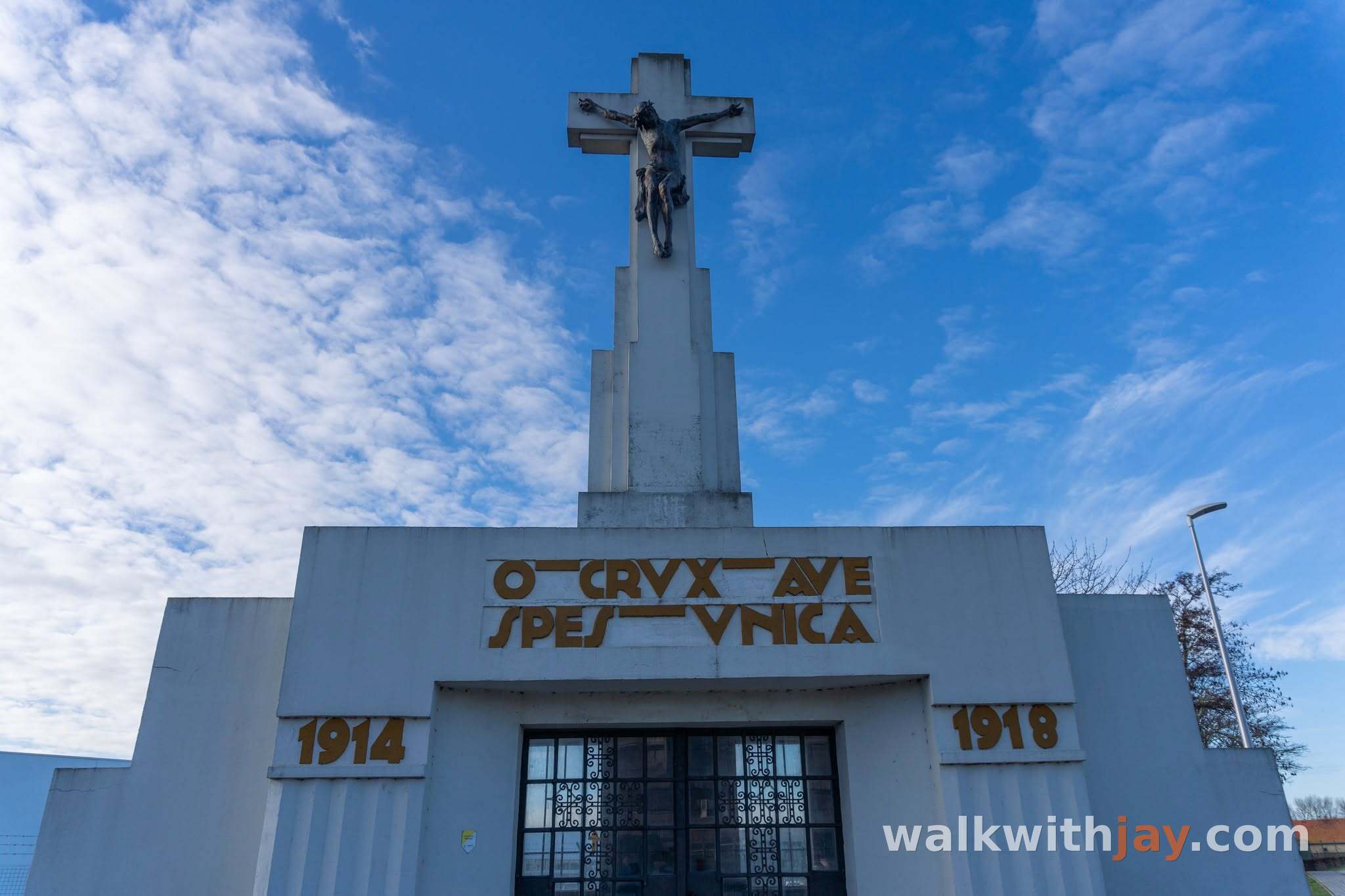
Calvarieberg
Along the route
Interwar religious memorial inaugurated in 1928 in memory of Allied soldiers killed on the Yser Front.
IJzerdijk 56, 8600 Diksmuide, Belgium ↗
Website →Ready to set off?
Open the starting point in your GPS and enjoy the walk.